README from GitHub, GPL-3.0
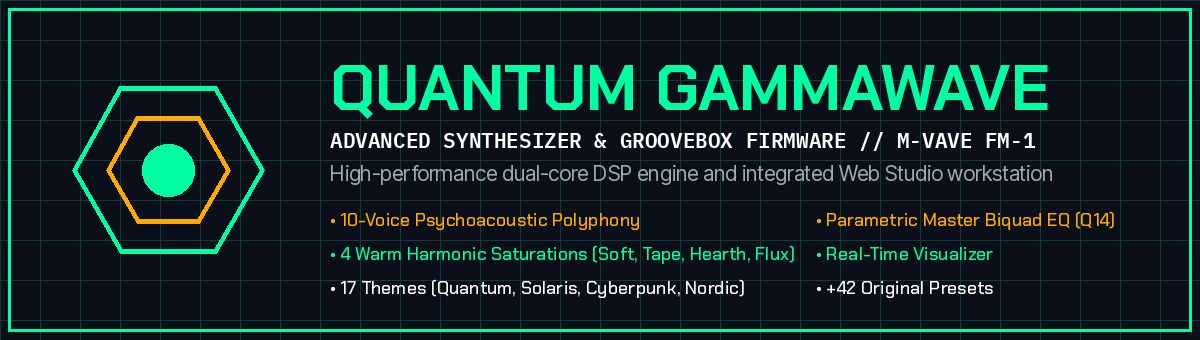
QUANTUM GAMMAWAVE (QG-1) — M-VAVE FM-1 Synthesizer & Groovebox Firmware
Advanced Open-Source Firmware & Web Studio for the M-VAVE FM-1 Groovebox (Dual-Core JieLi AC791N SoC)
10-Voice Psychoacoustic Polyphony · Direct Form II Parametric Master EQ · 4 Harmonic Saturations · 17 Curated Themes
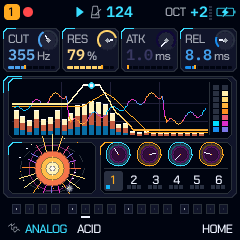
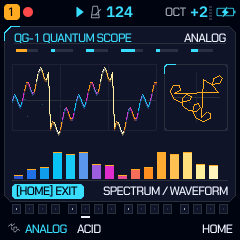
Pantallas reales de Quantum GammaWave en resolución nativa 240×240: a la izquierda, la pantalla principal HOME con analizador de espectro de 28 barras, sol Hearth y curva de filtro en tiempo real en la paleta insignia QUANTUM; a la derecha, el visualizador de pantalla completa (HOME → HOME) con el tema sonando: osciloscopio de fósforo doble, traza orbital de fase, las 16 barras de espectro con sus picos, los medidores de las seis pistas y las motas cuánticas en sus órbitas.
Quantum GammaWave (QG-1) is an independent, advanced open-source custom firmware and Web Studio workstation engineered specifically for the M-VAVE FM-1 multitrack FM synthesizer and groovebox (powered by the dual-core JieLi AC791N SoC). It delivers expanded 10-voice polyphony with psychoacoustic voice stealing, an expanded warm harmonic distortion suite, full-screen audio visualization, fixed-point parametric master EQ, real-time diagnostic telemetry, 17 curated visual themes, and an extensive preset sound library.
Web Site | guillel51.github.io/Quantum-GammaWave Firmware, screenshots, compatibility and every entry point below, in one page.
Web Emulator | guillel51.github.io/Quantum-GammaWave/emulator/ Runs the firmware as WebAssembly, no install and no hardware.
Web Studio | guillel51.github.io/Quantum-GammaWave/webapp/editor/ Editor, sequencer and telemetry over Web MIDI, or in mock mode without an FM-1.
USB Installer | guillel51.github.io/Quantum-GammaWave/webapp/installer/ Checks the package and the device identity before it writes anything.
Quantum GammaWave (QG-1) is dedicated firmware and workstation software engineered specifically for the M-VAVE FM-1 groovebox hardware.
- GitHub Repository: https://github.com/Guillel51/Quantum-GammaWave
- Official Documentation: English Manual (
docs/MANUAL.md) · Manual en Español (docs/MANUAL.es.md)
Portal and interface, current build
Public portal (/) | Public Web Studio (/webapp/editor/) |
|---|---|
 | 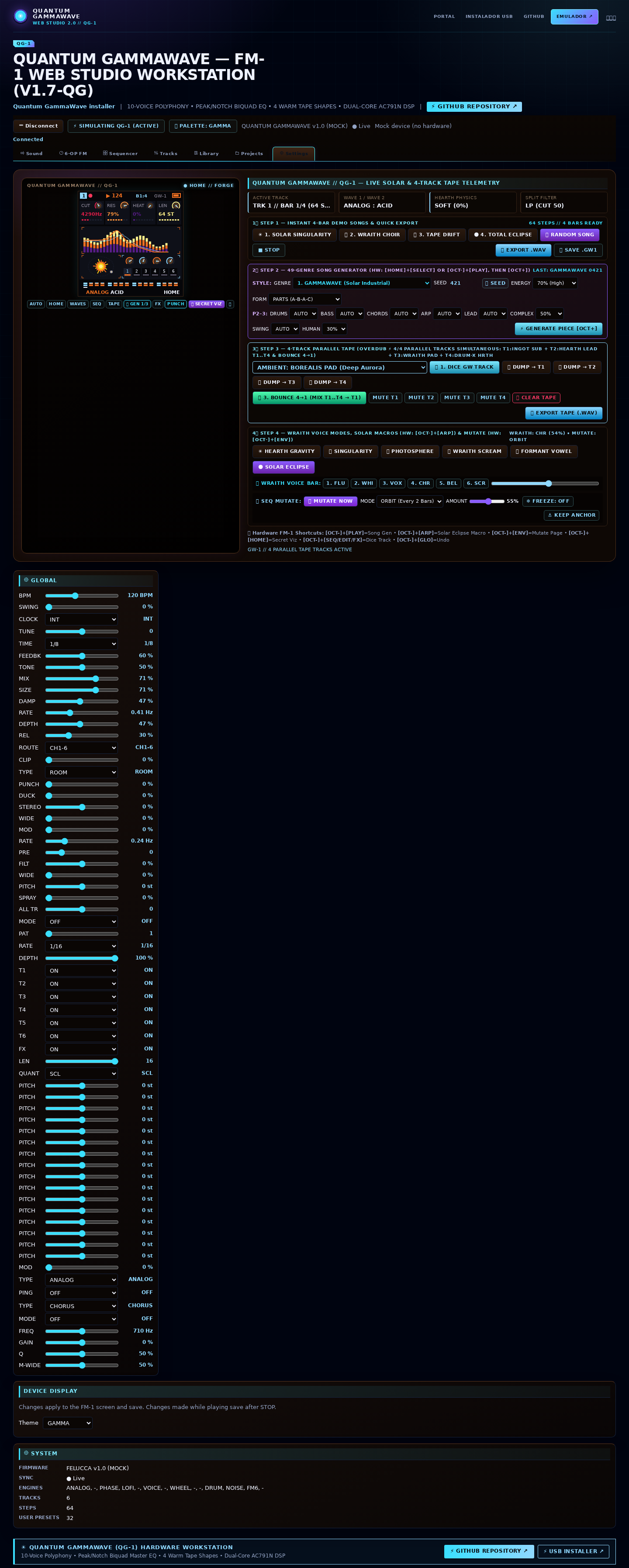 |
The portal is the official entry point and links the real WASM emulator, the USB installer and the Web Studio.
The screenshots above were captured in Chromium from the published build 0f52f48, not from localhost.
About Quantum GammaWave (QG-1)
Quantum GammaWave (QG-1) is an independent, self-contained open-source firmware and Web Studio workstation for the M-VAVE FM-1 multitrack groovebox. It is developed and maintained in this repository by its own contributors and released under GPL-3.0-only: a project in its own right, not a distribution, re-skin or mirror of anything else.
It targets the hardware's dual-core JieLi AC791N directly — an embedded DSP engine with 10-voice psychoacoustic polyphony, eight sample-free synthesis engines, punch-in FX and a fixed-point parametric master EQ, paired with a browser Web Studio for real-time sound design, pattern sequencing, diagnostics and USB flashing. The whole interface is drawn procedurally on the 240×240 display, with no bitmap assets in flash.
Independence does not erase where it comes from. Quantum GammaWave descends from and builds on Felucca, JIANT FM and Pocket GammaWave. Their authorship, licences and credits are preserved untouched in LICENSES/ and listed under Credits & license; those works remain theirs.
Web portal and Web Studio 2.0 (2026-11-04)
The project now has one official entry point: the Solar Heat / Quantum portal at
https://guillel51.github.io/Quantum-GammaWave/. It presents the firmware, real screenshots, compatibility,
installation warnings, version metadata and direct access to the emulator (/emulator/), the USB installer
(/webapp/installer/) and the Web Studio (/webapp/editor/). Existing installer and editor URLs are kept;
the emulator now lives at /emulator/, and /?emu=1 / /#emu redirect there for old links.
The Web Studio has a new presentation layer (deep charcoal, solar amber, cyan data accents, clearer hierarchy and a hardware-style brand bar) without changing any control id, SysEx frame, tab or protocol handler. It was checked in Chromium at 1440 px and 390 px: seven tabs, no horizontal overflow and no console or request errors. The emulator remains the same real WASM firmware; the portal only links to it.
v1.8.9 is the current build: the master EQ rounds its loop to the nearest value instead of down, so its DC gain is the coefficient's (+0.23 dB instead of -1.46 dB) and a -24 dB cut at 20 Hz reaches -24.14 dB instead of -17.61 dB; the four setters share one commit path and the RAM code budget gained 28 B. fm1_restore.py can write a verified backup back through an external SPI programmer. All of it is measured on the host and in the emulator: no unit, no physical restore, no production signing key. See docs/V1.8.9_STATUS.md.
What's in Quantum GammaWave (v1.8.9)
- Consonant random intervals (JIANT V10.38, adapted): GEN and the sound dice keep
INTon unison, fourth, fifth, octave or octave-and-fifth, within the parameter range; random macros never target an interval. Host test:tests/semi_test.c. - 10-Voice Polyphony with Psychoacoustic Smart Stealing: Expanded real-time polyphonic capacity from 8 to 10 voices across tracks. Utilizes psychoacoustic weighted-energy voice allocation to prioritize quiet release tails ($<-40\text{ dB}$) during voice stealing, preventing audible clicks while maintaining real-time DSP stability via dynamic load throttling.
- Harmonic Distortion & Saturation Suite: 4 musical, warm saturation topologies with dedicated algorithms:
SOFT(Musical Soft Warmth): Biased tanh soft-clipping with rich 2nd harmonic saturation.TAPE(Tape Warmth): Smooth cubic polynomial saturation with subtle tape saturation and head warmth.HEARTH(Tube Heat): Asymmetric tube bias curve with rich sub-bass reinforcement and smooth compression.FLUX(Analog Drift): Thermal tape flux saturation with subtle bias drift and tape head roll-off.
- Three Completely New Visual Themes with Exclusive Identities:
SOLARIS: Radiant solar gold, stellar corona amber, and forge embers on deep charcoal.CYBERPUNK: High-contrast synthwave neon grid with electric cyan and laser magenta highlights.NORDIC: Arctic obsidian black with emerald aurora borealis gradients and warm beacon accents.
- Expanded Sound Library (+42 Original Presets):
- Meticulously designed across all synthesis engines into 8 organized musical categories:
- Ambient: Borealis Pad, Cosmic Winds, Polar Aurora, Space Lullaby.
- Drones: Nebula Drone, Abyss Drone, Cyber Drone, Vox Drone, Wraith Drone.
- Bells: Crypt Bell, Temple Bell, Tibet Bowl, Shrine Bell, Chime Tree.
- Hurdy Gurdy: Hurdy Gurdy, Gurdy Drone, Medieval Viel, Gurdy Wheel.
- Acoustic & Traditional: Nordic Organ, Bamboo Flute, Folk Drone, Gothic Shrine.
- Ethnic & Experimental: Sitar Reson, Koto Harp, Gamelan Met, Shaman Chant, Tibetan Vox, Balafon, Ethnic Call.
- Evolving Pads: Wraith Pad, Solaris Glow, Aura Strings, Mystic Choir, Solar Hymn.
- Organic Plucks: Wood Pluck, Harp Pluck, Folk Pluck, Ethnic Pluck.
- Meticulously designed across all synthesis engines into 8 organized musical categories:
- Transient Preset Selection Overlay (PRESET Knob):
- Turning the PRESET encoder instantly shows the full 7-row categorized library overlay for 1.5 seconds without interrupting real-time audio playback.
- Dynamic Modern ARP Visualization:
- Real-time 16-step rhythmic pattern trajectory, direction mode visualization (UP, DN, UPDN, CONV, DIVG, CHORD, etc.), octave arcs, swing offsets, and tempo-synced live playhead.
- GLO 2 System Monitor (Diagnostics & Live Telemetry):
- Real-time hardware telemetry: active voice count, track-by-track polyphony distribution (T1–T6), dual-core CPU load and execution ticks (
mc_fx_tk), DSP buffer integrity, and master bus status.
- Real-time hardware telemetry: active voice count, track-by-track polyphony distribution (T1–T6), dual-core CPU load and execution ticks (
- Full-Screen Integrated Visualizer (
HOME -> HOME):- Tapping HOME while already on the HOME screen opens an immersive, hardware-native audio visualizer featuring harmonic oscilloscope traces, dynamic Lissajous phase orbits, and real-time audio telemetry, returning cleanly with a single press.
- Direct Form II Transposed Biquad Filter Engine (Peak/Bell & Notch): Fixed-point Q15 parametric EQ filters for precise surgical tone sculpting and master channel resonance cleanup.
- Visual Diagnostics & Virtual Device Simulator:
- Fallback virtual device simulator for Web Studio and WebAssembly emulator when physical hardware is disconnected or WebMIDI permissions are missing.
- Diagnostics modal providing instant connection troubleshooting, SysEx logging, and MIDI port state inspection.
- Quantum GammaWave HUD on the FM-1's 240×240 screen, in the GAMMA palette (default), plus THERMAL and WRAITH palettes:
- HOME: the selected track's filter response curve drawn over a 28-bar audio-reactive spectrum display, the Hearth sun with an orbiting moon, and the T1–T6 track strip.
- EDIT pages: two live scope traces above the Wraith ribbon — six zones (
FLU·WHI·VOX·CHR·BEL·SCR) whose needle follows the filter cutoff (and the filter LFO). With the VOWEL or SCREAM filter, or the VOICE engine, the ribbon shows the vowelsOO·OH·AH·EH·EEinstead. - Boot splash and updated ABOUT page with system metrics and credit lineage.
- 49-genre song generator (GEN) — open it with
[OCT−] + [PLAY], or turn SELECT on HOME. Page 1: KNOB 1 genre, KNOB 2 seed, KNOB 3 energy, KNOB 4 form (LOOP / PARTS / SONG); SELECT turns the five pages (drums, bass, chords, arp; lead, complexity, swing, humanize; SONG: tempo, key, scale, length; FEEL: space, fills, wet, grit); ALGORITHM gives the piece new instruments (the notes kept); OCT+ makes the piece, PLAY auditions it, HOME closes. The piece playing is NOW: every change shapes NOW (on the next bar while playing) and SAVE keeps it as a take — the TAKES reel (PRESETS) holds only the takes you saved (32, kept over power-off): scroll it (round) and the take under the cursor plays on the next bar (OCT+ or PLAY when stopped); there KNOB 1–3 are the tempo, key and energy, KNOB 4 picks a section, EDIT deletes, OCT− goes back. GLO + G4 / A4 step NOW back and forward. Hold OCT+ and the whole screen maps the keys: remake one part, one sound, one section, the harmony, the mix, drop a part while held, C#5 back to the original take, D#5 JAM (NOW changed by itself every few bars), F#5 the share code (OCT+ + SAVE types one in). Hold OCT− and the white keys play takes 1–16 on the next bar; REC records them as a SET. What a control did shows in a band at the foot of the screen. Genres include:TRAP ATL(136–150 BPM, half-time bounce, 808 sub, hi-hat rolls and triplets, bell / flute / key melodies)UK DRILL(140–145 BPM, 3-3-2 hi-hat gallop, late snare, sliding 808, dark strings and choirs)DARK TRAP(130–148 BPM, Memphis-style cowbell, clipped 808, phrygian bells)RAGE TRAP(140–160 BPM, Whole Lotta Red or MUSIC flavour: square video-game leads or wobbling stabs, a crushed 808)- plus
GAMMAWAVE,WRAITHWAVE, house, techno, trance, electro, EBM, synth pop, darkwave, post punk, motorik, funk, disco, boom bap, UK garage, dubstep, breaks, drum & bass, dub, jazz, bossa, afrobeat, ambient, neo-classical, soundtrack, IDM and more. - Pieces are 32 or 64 steps (2 or 4 bars per section) depending on the genre's chord rhythm.
- One-press MUTATE —
[OCT−] + [ENV]jumps to SEQ > MUTATE. If MUTATE was off on the track it switches it on with SOUND every 2 bars, PATTERN every 4 bars and AMOUNT ≈ 50 %:ORBIT(the default) mutates notes and timbre while pulling back toward the original pattern;DRIFTkeeps wandering. Intervals: 1, 2, 4, 8, 16 or 32 bars.- On the MUTATE page OCT− freezes the current mutation and OCT+ keeps it as the new pattern.
- Hearth macros —
[OCT−] + [ARP]steps through six drive/filter macros (1/6 HEARTH GRAVITY…6/6 SOLAR ECLIPSE!); macros 4–6 switch the filter to SCREAM or VOWEL, and 6 also raises the master DUCK and PUNCH.[OCT−] + [GLO]takes a macro back. - Hidden visualizer —
[OCT−] + [HOME](or MENU > ABOUT, then OCT+): four animated scenes,1/4 SUPERNOVA,2/4 WRAITH 3D,3/4 WARP TUNNEL,4/4 MATRIX FFT, which pulse while the sequencer plays. OCT+ (or PRESETS / ALGORITHM) changes scene, OCT− leaves. - Web Studio (browser, webapp/editor) — edits the FM-1 live over Web MIDI, or runs on its own in simulator mode:
- four instant demo songs and its own 49-genre generator (the same genre list; its patterns are generated in the browser and won't match the device's for the same seed);
- 4 tape lanes (T1–T4): DUMP a track's pattern into a lane, layer and bounce lanes, mute and clear them — they hold note patterns, not recorded audio;
- EXPORT .WAV: renders the current song and the tape lanes to a 16-bit 44.1 kHz stereo WAV for your DAW;
- the Wraith bar (six zone buttons, a 0–127 slider, or drag on the LCD) and SEQ MUTATE (MUTATE NOW, ORBIT, DRIFT, AMOUNT, FREEZE, KEEP ANCHOR).
The [OCT−] shift deck
Hold [OCT−] on its own first, then press the second button. (A plain OCT− tap still lowers the octave; the octave is put back when a shortcut fires.) The deck works from HOME and the parameter pages — not inside menus or dialogs, and not on pages where OCT− has its own job (on MUTATE it is FREEZE).
| Shortcut | Action |
|---|---|
[OCT−] + [ARP] | Next of the 6 Hearth macros (drive type and amount, cutoff, resonance, filter type) on the selected track |
[OCT−] + [PLAY] (or [REC]) | Open the 49-genre generator (GEN) |
[OCT−] + [ENV] (or [SCL]) | Jump to SEQ > MUTATE (switches MUTATE on if it was off) |
[OCT−] + [HOME] (or [SAVE]) | Open the visualizer |
[OCT−] + [SEQ] | Dice the selected track's sequence |
[OCT−] + [EDIT] | Dice the selected track's sound |
[OCT−] + [FX] / [OCT−] + [LFO] | Dice the track's FX / LFO |
[OCT−] + [GLO] (or GLO + G4) | Undo; again: redo |
The editing actions ask you to stop the song chain first (STOP TO EDIT), as their GLO-layer versions do.
Selecting tracks: turn ALGORITHM to select T1–T6 from any page. Tap EDIT repeatedly to step through the engine's pages: EDIT 1 → EDIT 2 → (MORPH, RETRIG or the FM6 operator pages, depending on the engine) → FILTER → VOICE.
Full user manual: English (docs/MANUAL.md) · Español (docs/MANUAL.es.md). Chapter 17 of the manual gathers the QG-1 additions (the shift deck, the Hearth macros, GEN, the new filter and drive types, the screens and the visualizer).
Firmware Renderer Gallery
All screenshots below are native 240×240 renders produced directly by the Quantum GammaWave (QG-1) firmware drawing code. They are renderer output, not photographs of a physical FM-1; the current branch regenerated the full gallery with tools/generate_screenshots.py.
1. Quantum Signature Suite & Core Views
| HOME Screen (Spectrum & Hearth Sun) | EDIT 1 (Wraith Cutoff Ribbon) | FM6 Operator Algorithms | Master Mixer (6 Tracks) |
|---|---|---|---|
| 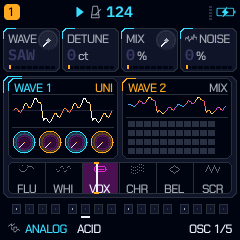 | 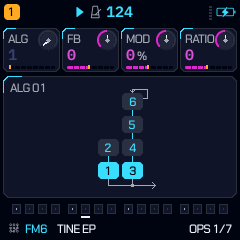 | 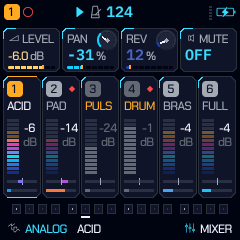 |
| Real-time 28-bar spectrum & filter curve | Dual VA oscillators & spectral ribbon | 32 DX7-style FM operator networks | Levels, pan, peak meters & sends |
Full-Screen Audio Visualizer (HOME -> HOME) | FX Send Rack with Peak Meters | MASTER Bus: Clip, Punch, Duck, VU | Transient Preset Browser (1.5s) |
|---|---|---|---|
| 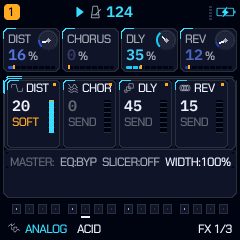 | 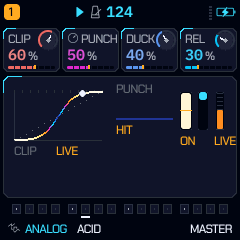 | 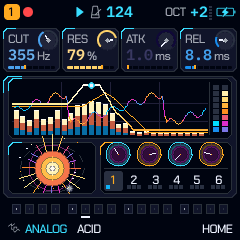 |
| Zero-crossing scope & Lissajous orbits | Real post-FX peak beside each send | Live clip curve, punch, duck gain & output VU | Fast 7-row categorized library overlay |
| Parametric Master Biquad EQ | GLO 2 System Telemetry |
|---|---|
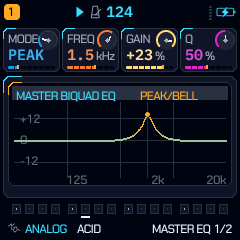 | 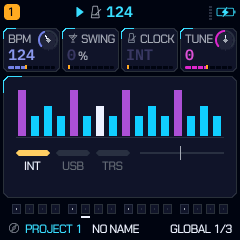 |
| Direct Form II Transposed Peak/Notch EQ | Active polyphony & dual-core CPU ticks |
2. Performance, Sequencing & Drum Synthesis
| Dynamic Modern Arpeggiator | DRUM-X Synthesized Pads | Playable Punch-In FX Grid | Motion Sequencer (MSEQ) |
|---|---|---|---|
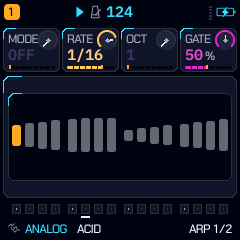 | 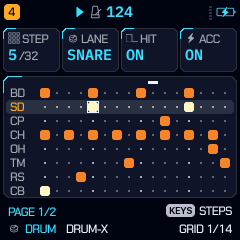 | 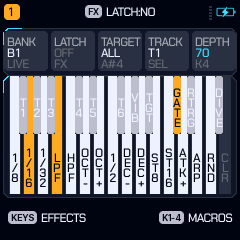 | 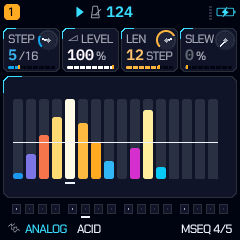 |
| 16-step trajectory, direction & swing | 8-pad synthesized percussion with morph | Quantized live performance repeats | Continuous parameter lane automation |
| Step Sequencer | Piano Roll Playhead | Hearth Macros Layer | Harmonic Performance Mode |
|---|---|---|---|
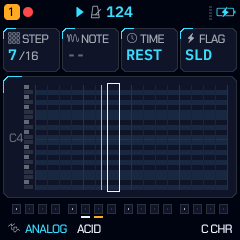 | 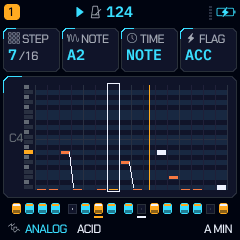 | 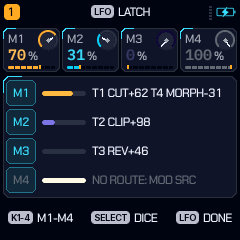 | 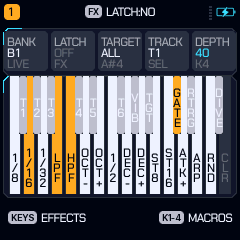 |
| Velocity, microtiming & parameter locks | Active note trajectories & ties | Expressive drive & filter macro shifts | Live scales, chords and filter curves |
3. Curated Visual Themes
| QUANTUM (Signature) | SOLARIS (Solar Gold) | CYBERPUNK (Neon Grid) | NORDIC (Obsidian Aurora) |
|---|---|---|---|
| 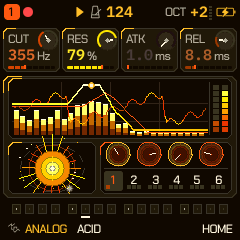 | 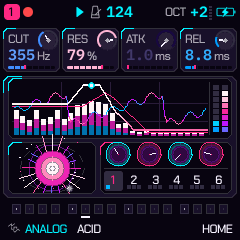 | 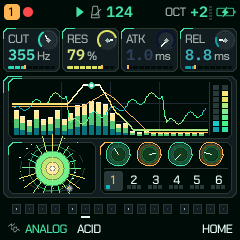 |
| Deep quantum indigo & Cherenkov cyan | Radiant gold, ember & corona amber | High-contrast synthwave magenta/cyan | Arctic emerald gradients on obsidian |
Synthesis engines & sound architecture
1. Eight synthesis engines (no samples)
ANALOG: dual virtual-analog oscillators (SAW,SQR,TRI,SIN,PWM,SYNC,RING,SAW3, and the dirty sinesTUBE— GammaWave's Hearth tube curve — andFOLD— WRAITH's Blast wavefolder — whose amount is MORPH plus ENV/LFO → SHAPE) with interval (INT ±24 st), detune, oscillator mix and noise, through the track filter (CUT,RES,DRIVE).FM6: 6-operator DX7-style FM (DX7.syxvoices load through the Web Studio), the 32 algorithms drawn on screen, per-operator editing on the device (OPERATOR,OP ENV,OPERATOR 2) and a 32-voice user bank (B1–B32; until you send one,B1–B11hold built-in default keys: electric pianos, bells, mallets, pads).PHASE: CZ-style phase distortion with feedback (FB), from warm brass to digital growl.LOFI: 1-bit, 4-bit and 8-bit chip voices plus 32-formula Bytebeat (BYTE) and Floatbeat (FLOAT) engines tuned to the keyboard scale.VOICE: formant voice (VOWEL,VOWEL2,TALK,SHIFT,BUZZ,BREATH) — its EDIT page shows the vowel ribbon.WHEEL: tonewheel drawbar organ with rotary speaker, key click and harmonic percussion.NOISE: tuned and free-running resonant / metallic noise for risers, snares and industrial textures.DRUM(the DRUM-X kits): 8 synthesized pads (BD,SD,CP,CH,OH,TM,RS,CB) with A/B kit morphing (MORPH), wavefolder (FOLD),FM ENV, an 808 long pitch-drop mode (PMOD LONG) and tempo-syncedX-MOD.
2. Filters and the Wraith ribbon (EDIT > FILTER)
Every track's filter offers LP, HP, BP, COMB, VOWEL (a state-variable filter blending low-pass, band-pass and a saturated notch for a vocal colour) and SCREAM (a state-variable filter with a saturated integrator, for screaming resonance). The Wraith ribbon labels the cutoff range with six zones (FLU · WHI · VOX · CHR · BEL · SCR); turning CUT sweeps the needle across it.
3. Punch-in FX, slicer, 5 reverbs & master bus
- Playable punch-in FX (
FXheld + keys): quantized performance effects (REPEAT 1/8 · 1/16 · 1/32,LPF,HPF,OCT-/+,1/2 TEMPO,DEC-/+,STUTTER 1/8 · 1/16,ATK+,ARP,RANDOM), recordable into a 4-bar automation lane per section. - 5 reverb models:
ROOM,SPRING,SHIMR(octave-up shimmer),RESO(4 scale-tuned sympathetic strings) andCLOUD(pitch-granulated freeze wash). - Master bus (
FX > MASTER):CLIP(level-compensated soft clipper),PUNCH(drum transient saturator),DUCK(kick-triggered sidechain pump) and an always-on 2:1 auto-leveler.
4. Dual-core audio engine (JieLi AC791N)
Some synth tracks run on the FM-1's second core, with per-block checksums and a watchdog. If the second core ever faults, the firmware shows a notice and stays on one core until power-off. Hold REC at power-on to force single-core mode.
Installing on M-VAVE FM-1 hardware
(QG-1) Web installer with SHA-256 check, pre-flight checklist, verify only and an automatic backup over GammaWave/JIANT; one-click launchers in
tools/install/(install-fm1.sh,.command,.bat); CLItools/fm1_install.py --verify-only / --sha256. Recovery guide (es): docs/INSTALL.es.md. Emulator while coding:python3 tools/emu_dev.py(rebuilds on every change and reloads the page).
- Open the USB web installer in Chrome, Edge or Opera (it needs Web MIDI): https://guillel51.github.io/Quantum-GammaWave/webapp/installer/
- Connect the M-VAVE FM-1 with a USB data cable and switch it on.
- Coming from another custom firmware (Felucca, baudgirl, etc.)? Click Return to official V15 first (which also backs up your flash), then click Install.
- Coming from official V15, JIANT, or earlier firmware? Click Install directly. Don't unplug the cable until flashing completes.
Quantum GammaWave uses the FM-1's user sample flash (USR1–3) to store 8 multi-section songs and the 32-voice FM6 user bank. Back up any custom WAV samples from stock firmware before flashing.
Read
docs/SECURITY.mdbefore flashing anything. It documents what the update protocol actually verifies (CRC, no signature), why an interrupted write cannot roll back on this single-bank layout, the community recovery ladder, and an honest audit of this repository's own installer — including what has not been tested on hardware. No install is declared safe without an independently demonstrated recovery path.
You can also download the package from the Releases page (named felucca-<version>.fwsc, e.g. felucca-v1.5-QG.fwsc — the build tooling keeps Felucca's file name).
Building from source
See BUILDING.md for the toolchain (JieLi clang, the AC79 SDK files) and the options:
./build.sh                                                       # build/felucca.fwsc (needs JIELI_TOOLCHAIN and AC79_SDK)
sh web/emu/build.sh                                              # the WebAssembly emulator in build/emu (needs emcc)
python3 web/make_site.py build/felucca.fwsc v1.8.9 build/site   # the Web Studio + USB installer
On Windows, tools/build_windows.py drives the same build inside WSL2 Ubuntu (edit its toolchain paths first).
Changelog
v1.7-QG — UI Evolution & Hardware Validation
- UI pass without regressions: the 171-screen lint and alignment sweep stays at 0 findings and 0 off-by-one measurements in all 17 palettes. HOME/EDIT's knobs are the round design from 1.6, and the splash and full-screen scope share HOME's instrument language, and the preset browser, matrix and visualisers were audited for overlaps and cut text.
- Budget analyzer:
tools/budget_report.pymeasures static RAM per voice count (8/10/12), the library's composition and the host CPU baselines, and states plainly what is host-measured and what needs a board. - Hardware simulation, documented:
docs/HARDWARE_SIMULATION.mdseparates emulation (the same C in wasm), host simulation (peripheral stubs, NOR, DMA, LCD, MIDI/USB) and physical measurement, and lists what the model does not cover: ISR timing, DMA bandwidth, flash erase time and dual-core contention. - Feature audit: macros, morphing, motion/automation, chord memory, the arpeggiator, the randomizer and
LFO phase/retrigger already exist; features that would need new persistent parameters (MIDI Learn, a global
LFO-retrigger switch, Preset Compare state) are documented as deferred in
docs/FEATURES_1.7.mdrather than shipped against the frozen project format. - No new persistent parameters.
P_COUNT, project sizes and SysEx layouts are unchanged; 200 sounds and the legacy DRUM indices stay exactly as verified for 1.6.
v1.6-QG — EVOLVE / MOTION, Touch & 200 Sounds
- A 200-sound factory library. The last two redundant DRUM kits (HEARTH KIT, CYBER DRUM) are retired
from browsing but kept as legacy entries at their old indices 10 and 11, so projects, favorites and user
presets load the exact sound they saved; the ten browsable kits keep indices 0..9. Sixteen new
sounds (pads, drones, textures, expressive keys, bells, plucks, leads, organs) were added across ANALOG,
PHASE, LOFI, WHEEL, FORMANT, NOISE and FM6.
tests/preset_library_test.pychecks the 200, each engine's share, DRUM's first ten indices and the names. - EVO, a new LFO wave. A smooth random walk (one new point per cycle, eased with a smoothstep), at a free
rate or a musical division on the transport's grid.
P_LWAVE = 6; the graph, the matrix, FADE and the LFO destinations all work with it. Demo sounds: QUANTUM BLOOM, ABYSSAL DRONE, OCEANIC PAD, EVOLVING GLASS, TAPE DRONE, SOLAR WIND, CATHEDRAL REED, TIDAL ORGAN, EVOLVE BELL, AURORA FM. - Touch. Channel aftertouch (MIDI
0xD0) reaches the matrix'sATsource as before; polyphonic aftertouch (MIDI0xA0) is now a per-voice source,PAT, for external controllers. The FM-1's own keys have no pressure sensor, so nothing pretends they do. Sensitivity is the matrix's AMT per destination (CUT, SHP, AMP, PITCH, VIB, E1..E8, FX sends), demonstrated by PRISM KEYS, GLASS BELL, AURORA PLUCK, BREATH CHOIR, VELVET EP and EMBER LEAD. - UI. HOME and EDIT's rotary knobs are real round knobs (filled body, 270-degree ring, value arc, needle, centre dot, no offset orbit ring), and the boot splash is one SURF card in the UI's own language: the seven-letter QUANTUM wordmark, a solar core with its corona and orbits, three waves writing across the frame and the 16-segment spectral horizon, instead of the old octagonal frame whose bands read as black lines.
- Verification. Host tests, sanitizers, UI lint/PNG renders and the 200-sound test pass; the emulator
rebuild is marked NO VERIFICADO when
emccis unavailable, and the 12-voice experiment stays off (docs/POLYPHONY_1.6.md). No bootloader or flash-critical change was made.
v1.5-QG — Startup, Preferences & Telemetry Release
- Startup without the four black lines: the ST7789 GDRAM is 240×320 while the blit clamps to 240×240, so 80 rows were never written;
lcd_gdram_clear()now writes all 76 800 pixels before the display is turned on (commit #37 only touched the backlight). Proven bytests/lcd_st7789_test.c, which models the controller's own command stream and reproduces the old windowed path first. - A new power-on screen: redesigned from scratch — chamfered octagonal frame, the seven letters of QUANTUM lighting one by one, a fixed spectrum rail with a playhead, then
v1.5-QGandQUANTUM GAMMAWAVE // QG-1.lcd_init(bg)now paints the whole 240×320 in the theme's background first, so no residue of the previous frame survives.MENU > STARTUP SPLASHstill chooses FULL / SHORT / OFF. - The splash costs less to draw:
splash_sig()compares the artwork it is about to paint with the one already on screen and returns when they match. Measured on the framebuffer over the real boot timeline: at v1.5, 425 steps of 4 ms, 160 changing and 265 identical rewrites skipped; after the v1.7 visual pass, 198 change and 227 are skipped (53 %, ~6.8 M pixels), with the final frame still asserted byte-for-byte equal to a whole draw. - GLO / CPU LOAD is live again: opening GLO left the UI rendering only the HOME visualizer's band, so
graph_diag()never ran, MONITOR's CPU LOAD froze on its first value and the section buttons did nothing.open_global()now clears that state andui_draw()guards it — GLO, FX, EDIT, SCL, LFO, ENV and SAVE switch section straight from the visualizer, without HOME, shortcuts and combinations untouched. MENU > EXTRAreachable from the editor:ED_MENU[]ended at index 21, soMENU_DESCreported "no item" for 22..24 andMENU_SETanswered "unknown id" whileINFOadvertised 25 settings with 22 real. CPU MODE, VIS QUALITY and SPLASH are appended as ids 22 / 23 / 24, matchingweb/EDITOR_PROTOCOL.md.MENU > EXTRA: three preferences, firmware and Web Studio together —CPU MODE(AUTO / DUAL CORE / SAFE SINGLE, AUTO by default, never forcing a core that failed),VISUALIZER QUALITY(HIGH / BALANCED / LOW: draw resolution, particles and refresh rate only, never the audio) andSTARTUP SPLASH(FULL / SHORT / OFF, hardware still initialised either way). Stored in the free bytes of the factory favourites record, so old records read as the defaults and need no migration.- GLO monitor from the real state: per-core split with each core's own time, CPU load, active voices, peaks, ticks, late blocks and fallback, redrawing on the data that actually changed.
- Six-track worst-case bench (
cpu/mix/6parts_fullintests/regress.c): the six parts at once, a different engine each, 8 notes held plus the drums and every send at 96. - Polyphony measured, not assumed: the 10- vs 12-voice experiment is built and run (§ of
docs/SECURITY.mdaside, numbers in the PR). 12 voices passes every health and voice check but changes two golden renders, costs +1008 B of SRAM and +11.6 % CPU on that bench, so 10 stays. steal_testfixed: it filled the shared budget with 7+1 notes, which was the whole budget when it was written; with 10 voices only three of its five scheduled notes stole one and the test failed its own "at least 4" on main.docs/SECURITY.md: AC791N/WL82 flash map, boot chain, what the update protocol really verifies, the single-bank power-loss window, the recovery ladder, and an honest audit of our own installer.
v1.4-QG — Quantum GammaWave Major Release
- 10-Voice Psychoacoustic Polyphony: Expanded real-time capacity from 8 to 10 voices across tracks with weighted-energy quiet-tail stealing ($<-40\text{ dB}$) and dynamic load throttling.
- Harmonic Distortion Suite: 4 distinct saturation topologies (
SOFT,TAPE,HEARTH,FLUX) with dedicated DSP curves infirmware/src/fx.c. - Parametric Master EQ Engine: Fixed-point Q14/Q15 biquad Direct Form II Transposed filters providing surgical Peak/Bell boost and Notch cleanup.
- Visual Themes Suite: 17 themes including exclusive additions
SOLARIS,CYBERPUNK,NORDIC, andQUANTUM, fully synchronized across firmware and Web Studio. - Expanded Sound Library: +42 original presets structured across 8 musical categories (Ambient, Drones, Bells, Hurdy Gurdy, Acoustic & Traditional, Ethnic & Experimental, Evolving Pads, Organic Plucks).
- Original Drum-X Kits: Added
QUANTUM BEAT,HEARTH KIT, andCYBER DRUMkits to the DRUM synthesis engine. - Full-Screen Audio Visualizer (
HOME -> HOME): Integrated real-time hardware oscilloscope, phase orbits, and audio telemetry accessible directly by tapping HOME. - Transient Preset Browser: 1.5-second non-blocking 7-row categorized library overlay activated by turning the PRESET encoder.
- GLO 2 System Telemetry: Live monitoring for active voice count, per-track polyphony distribution (T1–T6), dual-core execution load (
mc_fx_tk), and master bus integrity. - Dynamic Modern ARP Visualizer: Real-time 16-step rhythmic trajectory, direction visualization, swing offsets, and tempo-synced playhead.
- Web Studio & Emulator Upgrades: Seamless offline simulator fallback, enhanced connection diagnostics, SysEx logging, and responsive audio telemetry.
v1.3-QG — Audio Engine & Telemetry Enhancements
- CHORUS > TYPE PHASER: Four swept all-passes on chorus bus with persistent project state storage.
- Stabilized DRUM Render Output: Modularized
drum_outanddrum_addstages reducing cycle overhead while preserving bit-identical audio output. - QUANTUM Visual Palette: Added deep quantum indigo and Cherenkov cyan visual palette.
- Deterministic Randomization Checks: Enhanced DICE ALL engine verification ensuring balanced timbre evolution across multi-track throws.
- Platform Hardening: Added offline WebAssembly emulator fallback for non-Chromium and WebMIDI-restricted environments.
Credits & license
Quantum GammaWave (QG-1) is free and open-source software released under GPL-3.0-only.
Built upon the work of:
- Pocket GammaWave (GW-1) by Leo Kuroshita / Hügelton Instruments & ShadowTune.
- Felucca by Hügelton Instruments (Leo Kuroshita, @kurogedelic) — core FM-1 hardware abstraction, bootloader, engines, and the Fukiai icon font (MIT).
- JIANT FM — DRUM-X synthesis engine, dual-core audio scheduler, procedural generator foundation, and thermal font pipeline.
- SLOOP by isod89 — multi-section song arranger and live
SONG RECarchitecture. - Melodee (keremimo) & fm1-x0x (Charles Vestal) — AC791N second-core startup, memory-read guard, and WebAssembly browser emulator architecture.
- DSP & fonts:
msfa6-op FM from Dexed (Apache-2.0); formant synthesis after klattsch (MIT); Chakra Petch, IBM Plex Mono, Michroma, and DotGothic16 (SIL OFL 1.1).
M-VAVE and FM-1 are trademarks of their respective owners. Quantum GammaWave is an independent open-source project and is not affiliated with or endorsed by M-VAVE or Hügelton Instruments.