README from GitHub, GPL-3.0
Demake synth
An ambient lofi machine for the M-VAVE FM-1, built on its own recordings: 64 sounds made with pedals and kept as they were, played by three synths. Each synth has its own piano roll, its own patterns and a chain of lofi effects. Scenes combine the synths' patterns, a song arranges the scenes, and a chord machine leads them all. It is voiced like a late-90s console demake, and drawn in Geist with Kiloy's shapes: four greys, cards, and one thermal light, dithered, for what is lit.
- Play it in the browser: inigohernandez.github.io/demake-synth (the same core as the firmware).
- Install it: the installer page, over USB from Chrome.
- Read the manual: the manual.
Status: Demake 0.4.24 (FM-1_969), on the install page and the latest GitHub release.
What it does
- The sound.
- The 64 recordings are built in, like a rompler, with nothing to load.
- A filter with seven shapes (and off) and a drive, an envelope, and an LFO on the pitch, cutoff, level, pan or start, free or on the tempo.
- A layer: a second recording under a sound. Glide, velocity, the cutoff following the key, and grit (the voice at 22 or 11 kHz).
- Per synth: a Reverb of its own (room, plate, spring, hall), a Delay (a delay or ping-pong in time, a tape echo or grains) and Motion (chorus, vibrato, drift, ensemble, phaser, flanger, tremolo).
- Shared: the Space, one huge reverb all three send to (hall, space, haze, bloom, lofi, shimmer, reverse, freeze), and over the whole mix a Colour (saturate, crush, lossy, noise, warm, distort) and a Media (tape, cassette, VHS, vinyl, radio, dictaphone); each can be off.
- The music.
- Three synths, each with a piano roll of up to 256 steps and eight patterns of its own, recorded as played (micro timing, a strum's spacing), notes that can move in the scale and play by chance (Vary, on the roll, the chords or the arp), and an arpeggiator with Hold and thirteen ways to play.
- Sixteen scenes say which pattern each synth plays, and switch on the bar with HOME held and a white key.
- A song arranges the scenes, up to 128 steps of 1 to 8 bars, typed in or recorded live.
- The harmony.
- A chord machine with sixteen progressions and four of your own, voicings, strum and rhythms.
- The keys play chords on any page: sevenths, triads, ninths, add9, sus2, sus4, 6/9 or power; on the roll they write them.
- Each synth can play the chords, follow the key, the chord or the root, or harmonize another synth's notes.
- The rest.
- MIDI in and out over USB (and in on the TRS jack): notes by synth channel, the clock in or out.
- Fourteen songs and 32 of your own sounds are saved on the FM-1.
- Each start shows one of thirteen pixel landscapes (peaks, a lake, a beach at sunset, the night, a city from a bedroom, a 2000s desk, spruces in a blue fog after sunset, a living room with a CRT and a VHS deck, a pool house by the sea, a street of palms in California, a harbour in fog, a lighthouse on a cliff, a city skyline at night), and Home keeps one moving while you play; OCT− and OCT+ held show it full screen.
- Each sound is named after a plant, in Latin, one word.
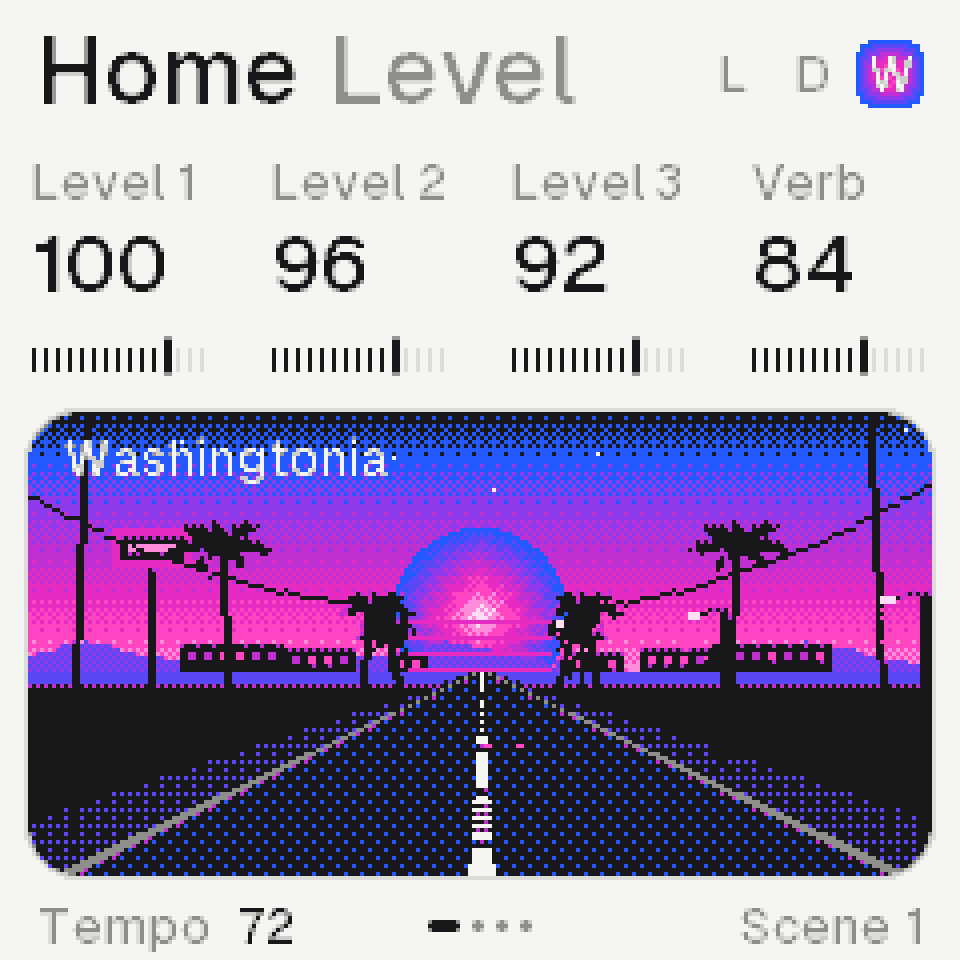
On the FM-1
- What it is to the FM-1. Identity
FM-1_969, the same for every release; over USB a MIDI device named "Demake FM-1" (its update loader, Felucca's, shows as "Felucca Update"). It carries Felucca's update loader. - What it keeps. Its own store: 64 KiB of the FM-1's data area,
0xB0000–0xC0000, holding up to 14 songs and 32 of your sounds. Installing Demake writes only its program, never the data area. Demake writes there only when you save (a song, a sound, or a song erased), a 4 KiB sector at a time, and reads only its own records (each has its mark and a checksum): it never loads another firmware's projects or samples. Other firmwares keep things in the same region (Felucca's samples, CoralFlower's loops), so a Demake save can overwrite what they kept there, and they can overwrite Demake's songs. MONO2K's store (0xC0000–0xE0000) is left alone. - Back it up. There is no backup tool for Demake yet: its songs and sounds live only on the FM-1. Before you
switch to a firmware that saves into
0xB0000–0xC0000, expect Demake's songs to be lost. - Leave it. Install another firmware as usual (the FM-1 Firmware Hub, or its maker's installer): Demake takes the package over USB and starts the new package's update loader.
- Rescue. Hold OCT− while switching on: the FM-1 starts the update loader only and waits for a package over USB. The installer page works from there.
Build
sh tools/check.sh                              # warnings, soft-float symbols, sanitizers, the self-test and the tour's text audit, wasm
sh web/build.sh                                # web/dmk.wasm; serve web/ to play it in the browser
.venv/bin/python tools/fm1/build.py            # build/fm1/demake.fwsc; --release X.Y[.Z] (FM-1_969 always), --diag (the load meter), --bench
The core is C99 and integer only (firmware/src, a unity build). The host harness (host/dmk_host.c) runs the
self-test, renders every screen as a PNG and counts the CPU. The plans:
- docs/plan.md: the whole design and every decision;
- docs/sound-design.md: the next stages for the sound and the song.
It runs on the open FM-1 platform of CS-1 and Felucca, as MONO2K does, so it is GPL-3.0-only (see
LICENSE). The notices of every source it uses are in LICENSES/ and firmware/fm1/LICENSES/. The
recordings are the author's own.