README from GitHub, GPL-3.0
Miku-FM
A singing songwriter firmware for the M-VAVE FM-1. A tiny pixel singer sings your songs in Japanese, consonants and all, over FM chords, bass and drums. Shape her voice, write patterns or let her generate a whole song, and watch her dance.


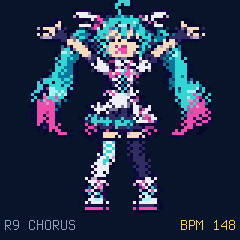
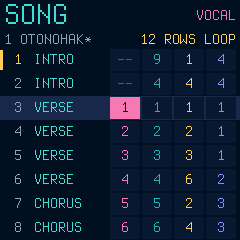
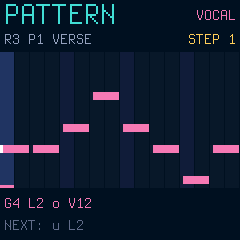
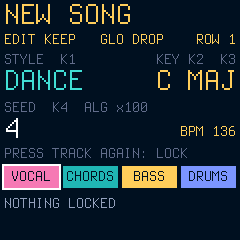
Try it in your browser, watch the trailer, install it: https://michaelaperry.github.io/MIKU-FM1/ (the emulator runs the real firmware package; the installer works in Chrome or Edge over USB).
- Her voice: a formant voice synthesised live (no samples): 70 Japanese morae with their consonants, five characters from DEEP to TINY, languages (Japanese, animal babble, scat, vowels), tension, fry, whisper, a harmony voice, vowels on the beat; chorus, delay, reverb, drive, tremolo. Every knob shows a picture of what it does.
- The song: four tracks (vocal, FM chords, bass, drums), 16 patterns per track, 64 rows with sections, mixer, swing, undo, 8 song slots. GEN writes a whole song in POP, BALLAD, DANCE or CHIP, with track locks and new phrases.
- The singer: her face mouths every vowel on STAGE; on DANCE she dances to the song.
- Status: development builds (0.x). Runs on a real FM-1 (installed with the browser installer; songs save and load). Controls: docs/CONTROLS.md, manual: docs/MANUAL.md, what is measured: docs/VALIDATION.md.
- Other firmwares' data: Miku-FM does not read other firmwares' projects or samples (see below). Back up first.
- Licence: code GPL-3.0-only; the singer is Hatsune Miku fan art under Crypton's Piapro Character License (free and non-commercial only): LICENSING.md.
The older host prototype
Build and render an editable eight-bar song
Requires a C11 compiler and CMake 3.16+.
cmake -S . -B build
cmake --build build
ctest --test-dir build --output-on-failure
./build/miku_demo demo.wav demo.mik
The demo composes four patterns in C: vowel-melody, three-note FM-like chords, FM bass, and kick/snare/hat rhythm. It serializes the song to versioned CRC-checked MIK1 bytes, decodes back to editable notes, and renders from the decoded song into 16-bit mono 22,050 Hz WAV.
demo.mik is a structured editable event file, not rendered audio. The demo is fixed eight bars (120 BPM); the UI, arrangement chaining, Japanese consonants, lyrics editing, and physical instrument support remain future work.
Architecture
shared/song.h— editable fixed-capacity 4-track event modelshared/song_io.c— versioned little-endian binary codec and CRC32firmware/sequencer/— precomputed sorted sample-time event queuesfirmware/audio/vocal/— independently written five-vowel formant synthesizerfirmware/audio/band/— original polyphonic chord FM, monophonic FM bass, electronic drumstools/demo.c— independent host harness rendering an eight-bar song
The 0.5 firmware (native/dinghy.c) is built from newer modules: firmware/song/ (song model, MKS2 file format, sequencer, mora table, demo song), firmware/audio/fmband/ (FM chords, bass, drums, mixer), firmware/audio/fvoice/ (the voice) and firmware/app/engine.c (the dispatch that runs in the audio interrupt). tools/song_render.c renders the demo through the same engine on the host: ./build/firmware/app/song_render otonohako.wav.
tests/— unit, serialization, and host-demo smoke tests
The current instruments use simplified synthesis and no effects, and there is no claim of measured audio or CPU quality on FM-1 hardware. See docs/RESEARCH.md, docs/SONG_FORMAT.md.
Host-engine code is MIT licensed; the firmware package is GPL-3.0-only (see Licence). Miku-FM is an unofficial fan project and has no relationship to Crypton, Yamaha or VOCALOID (see LICENSING.md). No voicebanks or proprietary assets are included.
Other firmwares' data
Miku-FM does not read other firmwares' projects or samples. It stores its songs in Dinghy's 8 slots (FM-1 flash 0x97000...) and a small settings struct in the settings sector (0xFC000), which other Felucca-family firmwares also use, so saving there replaces their data. Back up first.
Licence
The code is GPL-3.0-only (LICENSE; the firmware is built on Dinghy); files marked
SPDX-License-Identifier: MIT are MIT (LICENSES/MIT.txt). The singer's art is fan art of Hatsune Miku under Crypton's
Piapro Character License: free and non-commercial only, not under the GPL. Details, the credit and the list of art
files: LICENSING.md.
この作品はピアプロ・キャラクター・ライセンスに基づいてクリプトン・フューチャー・メディア株式会社のキャラクター「初音ミク」を描いたものです。 © Crypton Future Media, INC. www.piapro.net — Miku-FM is an unofficial fan project, not associated with Crypton Future Media, Yamaha or M-VAVE. 「初音ミク」 is a registered trademark of Crypton Future Media, INC.; VOCALOID of Yamaha Corporation.