README from GitHub, GPL-3.0
fm1-lofi
A lo-fi sampler that runs on the M-VAVE FM-1 itself, plus a web editor (one HTML file) that builds sample packs and sends them over Bluetooth (BLE MIDI) or USB.
- Samples are stored in the FM-1's flash as 16 kHz mono, 2 bit LMS-ADPCM: about 100 s of audio in the 520 KB the firmware has for a pack.
- The panel is a menu of ten screens (FX, SEL, ENV, LFO, EDIT, GLO, HOME, SAVE, ARP, SEQ), each with four parameters.
- Keyboard zones, scales, per zone envelope / LFO / start / end / reverse, four send effects with punch-ins, an arpeggiator and a live loop sequencer.
- The web editor (one HTML file, any Chrome or Edge, Web MIDI) imports audio, slices it, maps it to zones, previews the real 2-bit sound and uploads the pack.
Status: v0.9, experimental. The code is verified on the host (engine tests, upload protocol with packet loss and power-loss injection, a harness that runs the real firmware UI code). v0.9.3 has been confirmed working on a real FM-1 (boots, plays, stutter, free take); v0.9.1 and v0.9.2 are known bad (heap exhaustion). CPU load, BLE speed and latency have not been measured (CPU load, BLE speed, latency). The web editor has not been tried on a real FM-1 over Web MIDI.
Flashing replaces the firmware of your device. The flash page embeds the stock V15 image so you can roll back, but you do it at your own risk.
See docs/STATUS.md for the verification matrix, the open risks and the known limitations.
Screenshots
| Web editor: zones | Web editor: slicer |
|---|---|
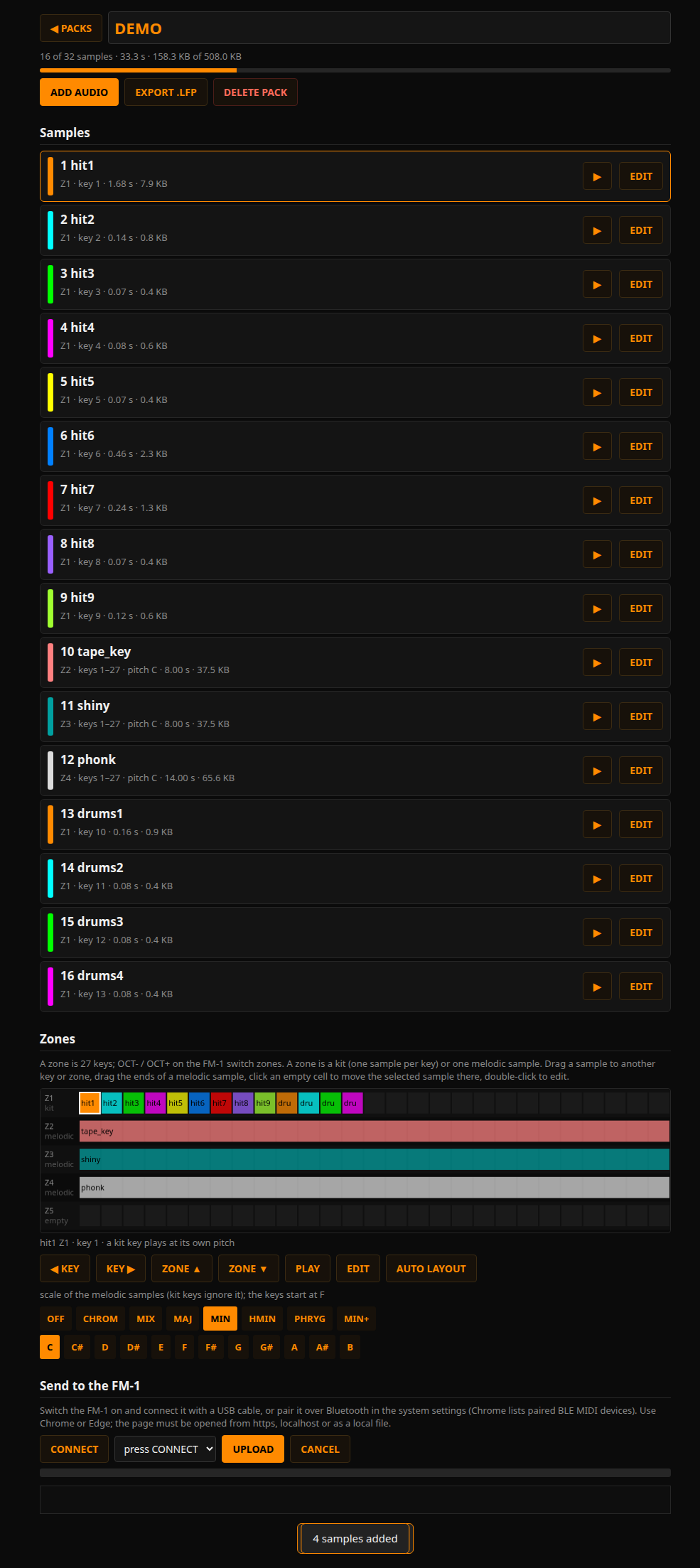 | 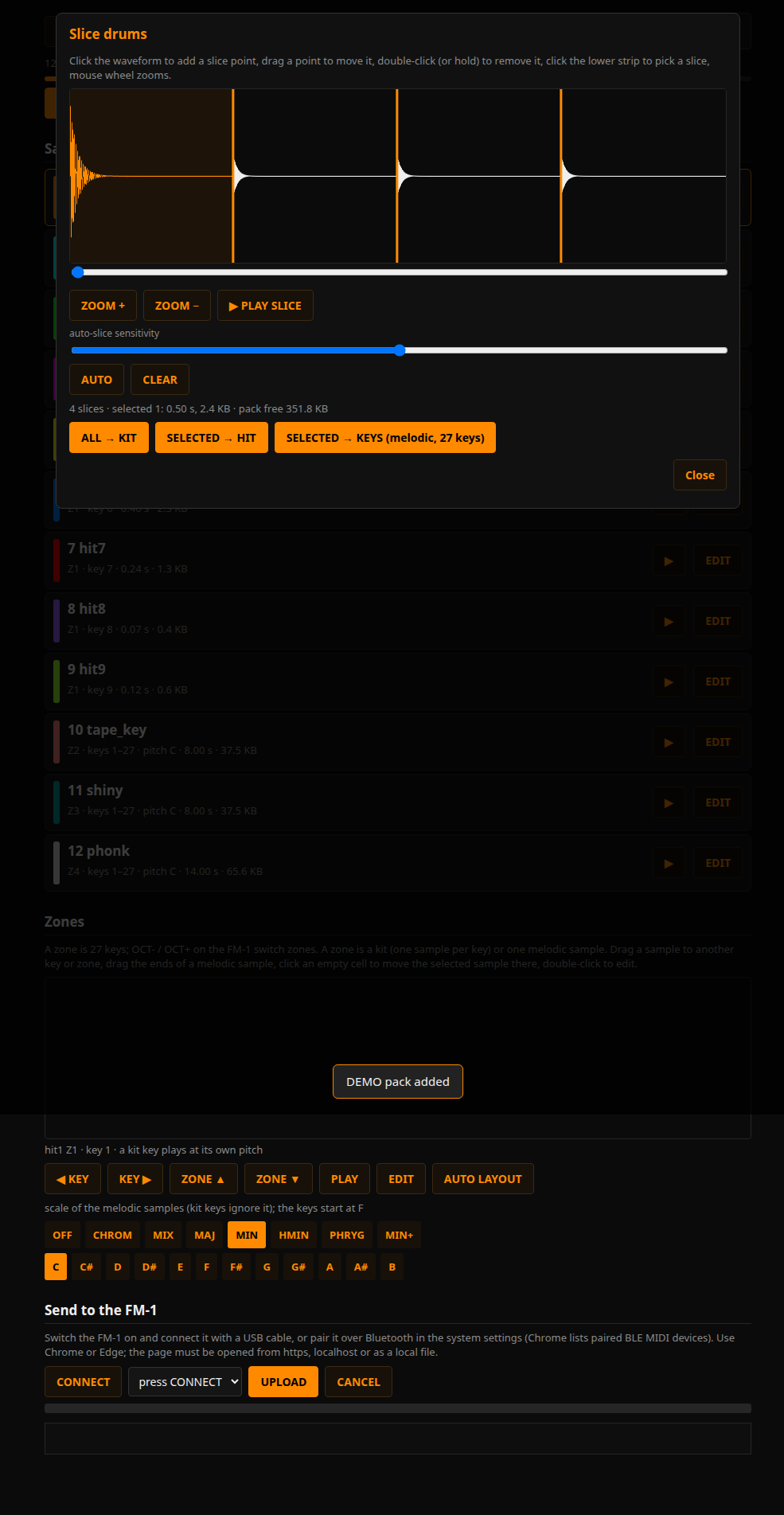 |
Firmware screens (rendered by the host harness): HOME, SEL, ENV, EDIT, SEQ. Sequencer: piano roll, free first take clock, resulting loop.
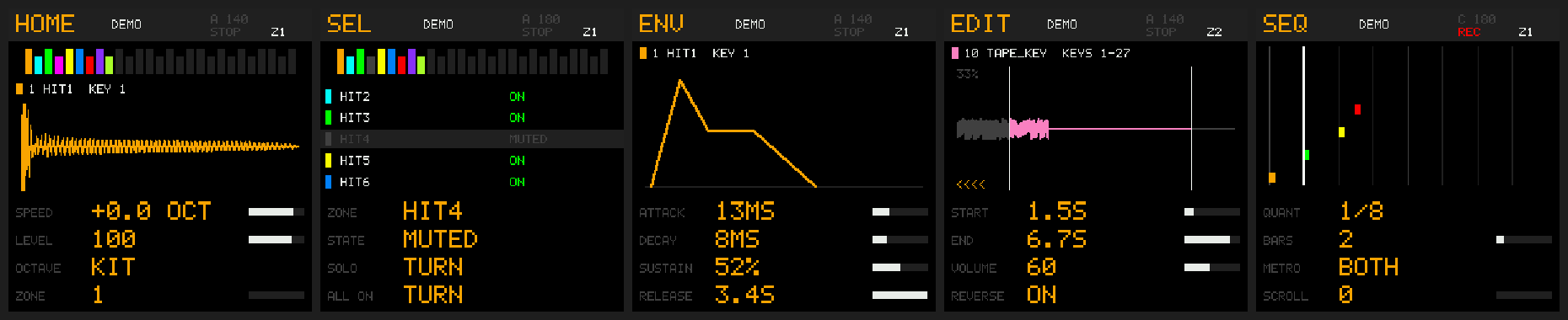
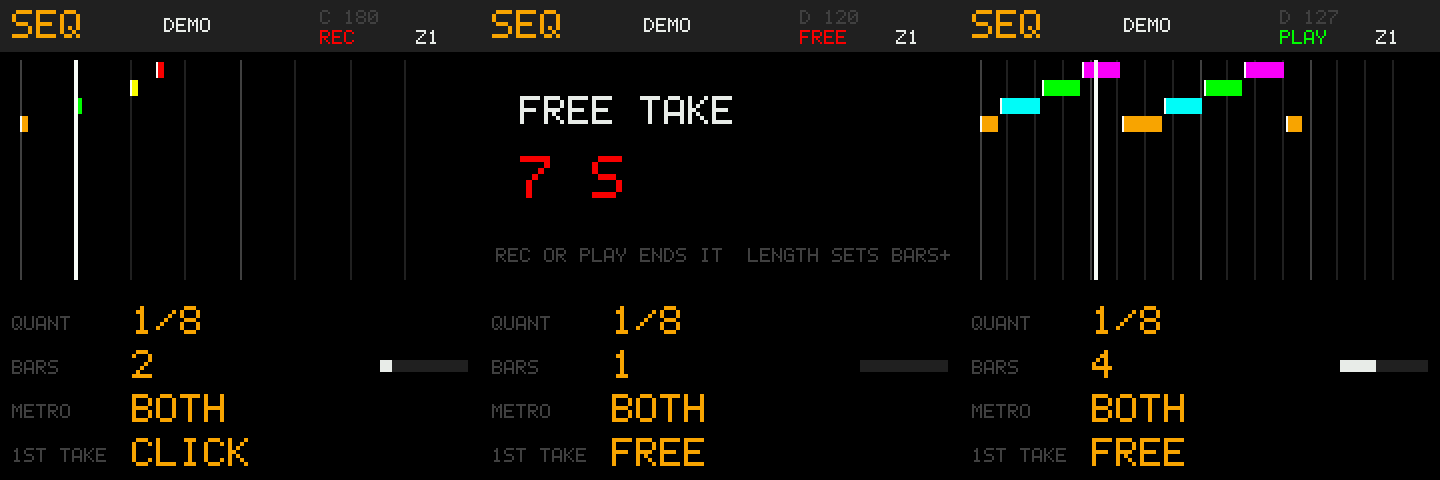
How zones work
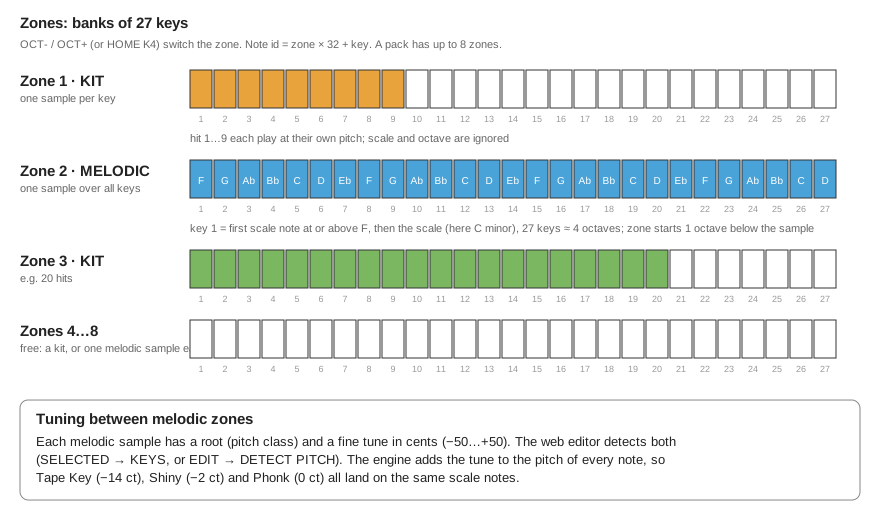
A zone is a bank of 27 keys, switched with OCT- / OCT+. It is either a kit (one sample per key) or one melodic sample spread over the keys as a scale. Details: docs/USER_GUIDE.md.
Documents
| File | Content |
|---|---|
| docs/USER_GUIDE.md | How to use the instrument: panel, every screen, zones, scales, sequencer, uploading a pack |
| docs/ARCHITECTURE.md | Hardware limits, repository layout, how the pieces fit, design decisions and why |
| docs/CODEC.md | The 2-bit codec: format, encoder, quality numbers |
| docs/PACK_FORMAT.md | The pack image, note ids, zones, flash layout |
| docs/UPLOAD_PROTOCOL.md | SysEx framing, commands, reliability, power-loss safety |
| docs/ENGINE.md | The sampler engine: voices, pitch, envelopes, LFO, effects, arpeggiator, sequencer, saved data |
| docs/FIRMWARE.md | The firmware UI code, the screen queue, persistence, build constraints and gotchas |
| docs/WEB.md | The web editor (replaces the app): usage, modules, tests |
| docs/BUILD_AND_TEST.md | Every build and test command |
| docs/STATUS.md | Verification matrix, risks, known limitations, ideas |
| docs/CHANGELOG.md | The running log of how the project was built |
Quick start (host)
# engine + protocol tests
cd core && for t in test_scale test_zone test_seq test_fx test_defaults; do
  gcc -O1 -DFM1_HOST_TEST -Wno-misleading-indentation -Wno-unused-function -I. -o $t $t.c lofi_engine.c -lm && ./$t | tail -1; done
gcc -O2 -Wno-misleading-indentation -Wno-unused-result -o sim_upload sim_upload.c -lm && ./sim_upload     # upload, packet loss, power-loss sweep
# firmware flash page (JieLi toolchain under wine, see docs/BUILD_AND_TEST.md)
python3 tools/build_fw.py firmware ~/fm1/wine/drive_c/JL/pi32      # -> firmware/build/FM1-Lofi-Workbench.html
Screenshots of the firmware screens (rendered by the host harness) are in docs/img/ (firmware_pages3.png = HOME, SEL, ENV, EDIT, SEQ of v0.6).
Built artifacts of every version are in releases/ (FM1-Lofi-Editor.html = the web editor, FM1-Lofi-Workbench.html = the flash page of the newest firmware, which embeds the stock V15 for rollback).
Repository layout
core/       portable C shared by firmware and tests: codec, pack format, upload protocol, sampler engine + tests
firmware/   fork of the FM-1 open firmware (fm1_open via fm1-daw): app/ (our UI, glue), sdk/ (vendor SDK + closed engine library)
web/        the web editor (JavaScript, one self-contained HTML file) + tests
tools/      build_fw.py (wine build), prototype codec, slicer, pitch test
docs/       this documentation
samples/    the source samples used for the tests (Tape Key, Shiny, Phonk, TrapKit)
out/ mp3/ slices/   test renders and listening files
releases/   flash page and web editor (release assets, not committed)
Licence
The firmware is a fork of the GPLv3 FM-1 open firmware (with the SDK linking exception); the vendor SDK/engine library has its own terms (see firmware/THIRD_PARTY.md). The SEA-style codec derives from MIT code (Dani Biro; M-VAVE modifications).
Install
- Firmware: open
FM1-Lofi-Workbench.html(release asset; Chrome/Edge, Web MIDI/USB) and follow the page. Rollback to stock V15 is on the same page. - Sample packs: open
FM1-Lofi-Editor.html(release asset, one file, works offline), import audio, slice, map to zones, CONNECT and UPLOAD over USB or BLE MIDI. See docs/WEB.md.
Tests
# C
cd core && for t in test_scale test_zone test_seq test_fx test_defaults; do gcc -O1 -DFM1_HOST_TEST -w -I. -o $t $t.c lofi_engine.c -lm && ./$t | tail -1; done
# web (node 24)
node web/test/test_codec.js && node web/test/test_pack.js && node web/test/test_pitch.js
A CI workflow with the same commands is provided (docs/ci.yml.example, copy it to .github/workflows/ci.yml). Building the firmware needs the JieLi toolchain under wine (docs/BUILD_AND_TEST.md).
Contributing and credits
Issues and pull requests are welcome, especially hardware measurements and bug reports from a real FM-1. This project is not affiliated with M-VAVE; "FM-1" identifies the compatible device. Third-party components: firmware/THIRD_PARTY.md. The 2-bit codec derives from the MIT-licensed SEA codec.
Licence
GPL-3.0 (LICENSE). firmware/ is a fork of the GPLv3 FM-1 open firmware with the SDK linking exception (firmware/LICENSE.md); the vendor SDK keeps its own terms (firmware/THIRD_PARTY.md). Demo audio: see samples/README.md.